





A clear, family-friendly guide for Jerome-area families comparing safety, staffing, medical needs, and dignity—plus a local angle for Twin Falls and Boise.
When “something has to change,” the next step should feel clearer—not scarier
Many families in Jerome, Gooding, and the greater Twin Falls region reach a moment where home is no longer the safest or most sustainable option—yet “moving to a nursing home” may not actually match what your parent needs. Assisted living and nursing homes are both forms of senior care, but they’re designed for different day-to-day realities. The best choice usually becomes obvious once you match your loved one’s needs to the right level of support: personal care and supervision vs. around-the-clock skilled medical care.
The simplest way to think about it
Assisted living is primarily about help with everyday life—bathing, dressing, meals, mobility support, medication assistance, and consistent supervision—while preserving independence and routine.
Nursing homes (skilled nursing facilities) are primarily about medical complexity—ongoing nursing care, frequent clinical monitoring, and higher medical oversight (often after hospitalization, surgery, or with advanced conditions).
Care needs: what each setting is built to do well
Assisted living: daily support + safety + routine
Assisted living is often a strong fit when a person is not safe living alone (falls risk, missed meals, confusion with medications, wandering risk, or caregiver burnout at home), but does not require intensive medical treatment every day.
In Idaho, assisted living communities are regulated as Residential Assisted Living Facilities (RALFs), which provide supervision, personal assistance, meals, and lodging—and must ensure a licensed nurse is available when a resident’s needs require nursing support.
Nursing homes: skilled nursing + clinical oversight
Nursing homes are designed for people who need regular hands-on medical care and monitoring—complex medication management, wound care, IV therapy, frequent therapy/rehab needs, or higher medical instability.
Nursing facilities that participate in Medicare/Medicaid must meet federal requirements (including 42 CFR Part 483) and are surveyed for compliance.
Side-by-side comparison (quick clarity)
| Decision factor | Assisted Living | Nursing Home (Skilled Nursing) |
|---|---|---|
| Primary purpose | Help with activities of daily living (ADLs), supervision, routine | Ongoing skilled nursing and medical oversight |
| Medical intensity | Typically lower; coordinates care and supports medications | Higher; clinical monitoring and skilled services |
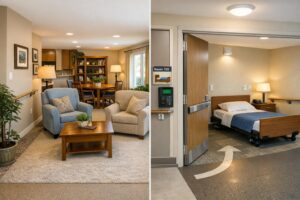
| Living environment | More home-like; social programming is central | More clinical due to medical needs |
| Best fit | Needs daily support + safety, but not intensive skilled care | Complex conditions, post-acute rehab, or ongoing nursing needs |
| Cost trend (national medians) | Often lower than nursing homes | Often higher due to medical staffing |
Practical tip: if your family disagrees, use this table as a shared “scorecard.” Circle what’s happening weekly (falls, medication errors, wandering, nighttime confusion, missed meals) and what’s happening medically (wounds, injections, advanced oxygen needs, frequent hospitalizations). Patterns make decisions easier.
How to decide in 30–60 days: a step-by-step approach
Step 1: Write down “the hard moments” from the last 2 weeks
Families often remember the crisis day, but the day-to-day tells the truth. Note specific moments: missed meds, getting stuck in the bathroom, leaving the stove on, nighttime wandering, refusing showers, or eating less because cooking is overwhelming.
Step 2: Separate “care needs” from “medical needs”
Care needs are ADLs and supervision (bathing, toileting, dressing, meals, mobility, cueing). Medical needs are skilled tasks and clinical monitoring. If the concern is primarily safety + daily support, assisted living is often the right starting point. If the concern is frequent skilled interventions, a nursing home may be more appropriate.
Step 3: Ask what nights look like
Many families manage “most days” but can’t safely cover nights. If nighttime confusion, falls, or wandering are increasing, prioritize communities with dependable round-the-clock supervision and support.
Step 4: Tour with a short, specific checklist
When you tour, you’ll hear a lot of information. Bring questions that tie directly to your loved one’s needs:
Tour checklist:
• How is the care plan created and updated as needs change?
• How do you handle medication assistance and coordination with providers?
• What does support look like overnight?
• For memory concerns: how do you support dementia behaviors with dignity (redirection, routines, secure areas)?
• What happens if needs increase—can the resident stay, and what changes?
If your parent is resistant, aim for “trying support” rather than “giving up independence.” Short stays can be a calmer bridge for many families. If that’s helpful, DeSano Assisted Living offers Day & Respite Care as a flexible option.
Where memory care fits into this decision
Memory care is not “more of the same” with a different label—it’s a specialized environment and approach for Alzheimer’s disease and other dementias, often with added safety features, structured routines, and staff training tailored to cognitive changes.
If your loved one is showing unsafe wandering, frequent disorientation, or escalating confusion, a community offering dedicated memory support may provide a safer, calmer daily rhythm. Learn more about DeSano’s Memory Care and how dementia support can be personalized with patience and consistency.
Helpful nuance: it’s common for families to think “nursing home = dementia care.” In reality, many people with dementia do best in a memory care setting unless they also have complex medical needs requiring skilled nursing.
Local angle: what to know in Jerome, Twin Falls, and Boise
In Southern Idaho, families often compare options across Jerome, Gooding, and Twin Falls—especially if one sibling lives closer to Boise and wants to be involved in tours and decision-making. Two practical realities tend to shape the timeline:
1) Distance changes what “help at home” can realistically look like.
If caregiving depends on someone driving in from Boise or coordinating from out of town, consistency becomes hard fast—especially with medication timing, meals, and nighttime safety.
2) A family-style setting can reduce stress during the transition.
When a move is emotionally loaded, many families look for a warm, home-like environment where routines feel familiar. DeSano Assisted Living serves Jerome and Gooding with compassionate assisted living and memory care—and can coordinate outside therapies when needed through Therapies & Medical Coordination.
Want a feel for the environment? Browse the Photo Album before you tour.
Ready for side-by-side clarity for your family?
If you’re comparing assisted living vs nursing homes and want a straightforward recommendation based on your loved one’s daily needs, schedule a tour or call to talk through options—especially if you’re trying to align siblings and make a plan within the next 30–60 days.
FAQ: Assisted Living vs. Nursing Homes
Does needing help with bathing mean someone needs a nursing home?
Not necessarily. Help with bathing, dressing, meals, and reminders is often exactly what assisted living is built for. Nursing homes are typically the better match when skilled medical care and clinical monitoring are needed consistently. (cms.gov)
What if my parent has dementia—assisted living or nursing home?
Many people with dementia thrive in memory care (often offered within assisted living) because it’s designed around safety, routine, and supportive redirection. A nursing home may be appropriate if dementia is paired with complex medical needs requiring skilled nursing.
Are assisted living facilities regulated in Idaho?
Yes. Idaho regulates assisted living as Residential Assisted Living Facilities (RALFs) that provide supervision, personal assistance, meals, and lodging—and must ensure nursing availability when a resident’s needs require it. (healthandwelfare.idaho.gov)
Can assisted living coordinate therapy (PT/OT/speech)?
Many communities coordinate with outside providers. At DeSano Assisted Living, therapy services can be coordinated through their in-house team via Therapies & Medical Coordination.
What’s a good “bridge” option if we’re not ready for a permanent move?
Respite care can be a practical trial run—giving a caregiver a real break while your loved one receives support and supervision in a safe environment. Learn more about Day & Respite Care.
Glossary (plain-language definitions)
ADLs (Activities of Daily Living): Basic daily tasks like bathing, dressing, toileting, eating, and moving safely.
Assisted Living (Idaho RALF): A licensed group living setting in Idaho that provides supervision, personal assistance, meals, and lodging.
Memory Care: Specialized support for Alzheimer’s and other dementias, often with added safety, structure, and dementia-trained staff.
Skilled Nursing Facility (SNF): A nursing home setting providing skilled medical care and regulated under federal requirements for Medicare/Medicaid participation.